Standing in Another’s Shoes: The Praxis of Horizontal Spirituality and its Transforming Power
Please request my Masters Thesis ©2017-2025
And the howl of the orphans is passed from one generation to the next, as in a relay race: the baton never falls. –Yehuda Amichai –
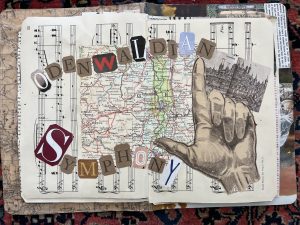
Meanwhile, find some musings and a thesis summary below.
Trauma was and is a fact of life. Trauma can be mundane like a car accident, or horrific like being a prisoner in a concentration camp, a sudden terminal diagnosis, and so, so much in between. Trauma can infuse the very air we breathe. We may grow up in a traumatising, and (likely) traumatised family. We may live in a war zone. We may experience violence, oppression and social injustice; the list is endless.
We can ignore this, deny our experiece of it, pity sufferers, wish them well, or pray it may continue to spare us. Alas, none of this is likely to make trauma, at large, go away any time soon. What’s more, while there are many resources to live with trauma, there is no way to get trauma-proofed.
This vignette of my masters thesis, proposes as the best course of action in the face of trauma, is to engage in mending trauma, our own (if we have lived experience) AND in that of others, creating pockets of mutual aid communities through joining events that use Constellating Systems as their backbone and tool.
Yehudi Amichai, a prominent Hebrew poet, knew all about the nature of trauma. His lines above point us to generational/ancestral trauma. He writes about “the howl of the orphans … passed from one generation to the next, as in a relay race.” Amichai knows that, without mending, “the baton never falls'” but is handed from one generation to the next. In his generational heritage -Holocaust Terrors- profoundly lamentable, indeed. For the offspring of victims and perpetrators, more often than howls and laments, the companions of ancestral trauma are silence, depression, despair, and loyalty (to the deceased victims and perpetrators, respectively.)
The Grandfather, a soldier in the SS. The great-grandmother, swallowed by the ground in San Francisco. Bodies, littered along dirt roads in a war zone. “Strange fruit’ (a hanged body) slowly turning on a branch in the evening breeze …. While any of these may be kept silent, even secret, the effects of ancestral and socio-historical trauma resurface in descendants as (often) intractable physical, emotional, and fractal-event suffering. In the last three decades their presence and increased visibility brought epigenetic research and ancestral-cause-theories to the fore, making distant trauma, as the source of suffering in contemporary lives, ever more real.
Many traditions have passed on wisdom teachings, holding that every generation is responsible to mend their personal, their society’s, as well as their unredeemed forbears’ trauma. They insist that no one can heal alone. What’s more, no individual’s mending will do, as long as their community suffers. A newer form of working on mending our nested worlds, the many systems we belong to, is what I named horizontal spirituality. It is at work when communities gather to practice Systemische Aufstellungsarbeit or, in North American language, Family and Systems Constellation Work (F&SCW).
Developed by Bert Hellinger, as Familienstellen in 1970’s Germany, the method and its communal application blossomed. The rapid, albeit not uncontested growth of F&SCW in Germany, and its remarkable expansion and reception by worldwide constellation communities, is exciting. The broad scope and colourful expression of applications is inspring, its efficacy in many instances, is stunning. Most alluring, albeit confounding, is the Wirkmechanismus (the ‘What-Makes-It-Work’?).
F&SCW is a community-based method to access, process, and mend ancestral trauma. The goal is to see, experience, and honour broken connections in the past to mend them in the present. Constellating invites individuals to share their issue with withnesses in a group. Participants, then, are invited to stand in the place of a part of the system, connected to the respective issue. By simply standing in the designated ‘role’s spacial presence in the circle, their bodies perceive information about strangers they have no way of knowing. Even, the long-dead.
Enmeshment with generational patterns tends to echo deeply throughout lineages, for better AND for worse. We inherit many traits of forbears as cherished learnings of yore. We also inherit their unmended trauma. Inviting historical events and the ancestors who survived is a way to see and withness what was denied, became a secret altogether, or simply forgotten. The gift of representing these events and forbears opens their lives to the vulnerability among those present.
Mending in community circles, as Olam Tikkun and other wisdom schools would assure us, reaches and soothes ancestors and generational systems through our attention and intention of learning and honouring what we learn. T his means, we simultaneously engage personal, communal, and sociohistorical trauma, while being nourished by the lived experience of a gatheirng in which we mutually partake in each others’ mending the world.
When I explained F&SCW to my greatly appreciated professor, Dr. Albert Hernàndez, he answered “The Holy Spirit at work.” Despite the good fortune of having been a studen at Iliff School of Theology, the Christian Household is not my spiritual home. Cracious spaciousness among faculty and peers, still allowed me a closer look at the transformative spiritual nature of representing in F&SCW, as the the value and effect of representative perception, as service to Self and Other, a relational, horizontal spiritual practice, seemed to have been understated.
My thesis, therefore, emphasises the effects of representing:
1) Experiencing an other’s trauma and pain is an intimate connection with experiences we might never have. This parallels teachings in numerous compassion traditions.
2) The practice of representative perception expands epistemological boundaries beyond one’s personal experience.
3) The practice of representing is a vehicle to travel beyond one’s horizons of experience and generates intra-relational lived experience of an other.
4) Participation in ‘mending the world’ – beyond one’s own – eventually cross-connects the communities of participants in a committed group.
5) Representing is the relational, embodied praxis of horizontal spirituality.